Keep these rules in mind to make your profit-sharing journey smoother
More and more traders are choosing EagleTrader Max. Seeing people around you receive generous profit shares one after another, are you also eager to give it a try?
But as the saying goes, “Sharpening the axe does not delay the chopping of wood.”
If you only have a vague understanding of the trading rules, you may very likely feel constrained when trading.
To this end, we compiled a centralized review of the rules most frequently asked about in our customer service backend recently.
We hope this article can help you completely clear up blind spots and steadily pocket your profit shares as soon as possible!
Q1: What is the dynamic drawdown rule?
The core of the dynamic drawdown rule is to ensure your account safety: your risk control line will “rise with the tide” as your account profits increase.
Simply put: your risk control line is not fixed; it dynamically moves upward based on the higher of your account equity or balance.
The rule mainly includes two dimensions:
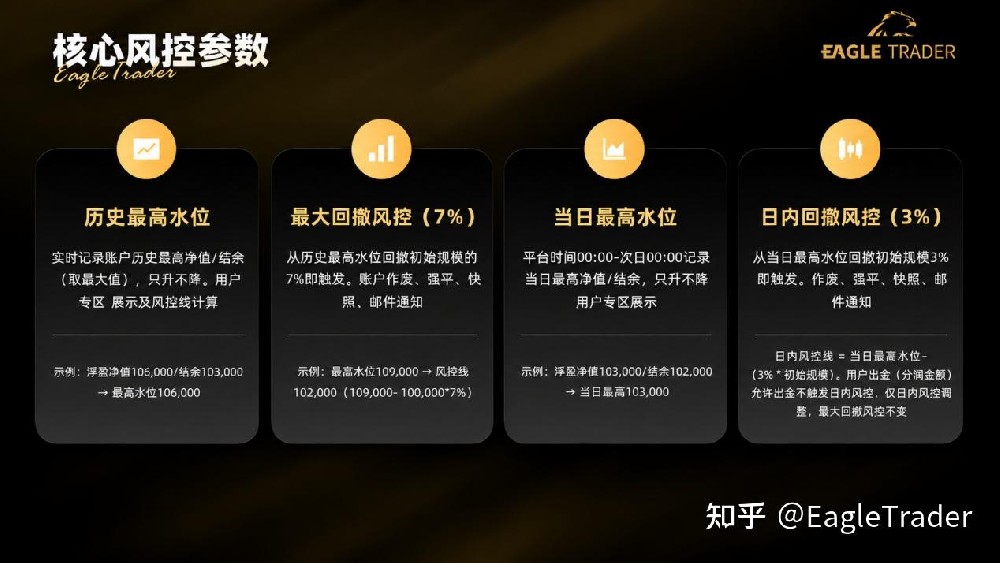
Maximum drawdown (7%): triggered when the account retraces 7% of the initial size from the historical high-water mark.
The historical high-water mark refers to the higher of the historical highest values of your account equity and account balance recorded in real time by the system.
The historical high-water mark always records the highest equity/balance your account has reached historically, and it only rises when equity/balance reaches a higher level; it never decreases.
For example, if the account size is $100,000 and your highest reached level is $109,000, your risk control line will move up to $102,000 (109,000 - 7% of the initial size of 100,000).
Daily drawdown (3%): triggered when the account retraces 3% of the initial size from the day's high-water mark.
Neither the account equity nor the account balance may reach or fall below the daily drawdown risk control line within a single platform day.
For example, if your account's high-water mark today is $103,000, then your risk control line today is $100,000 (103,000 - 3% of the initial size of 100,000).
Why set this rule?
To force you to develop the habit of “moving stop-loss” (for the 7% long-term drawdown). Many traders tend to get “carried away” after making a profit, feeling that a profit buffer allows them to relax their vigilance.
The dynamic drawdown mechanism will force you to keep moving up your overall defense line as the market develops, protecting the fruits you have already earned.
2. Force you to learn to “stop trading” (for the 3% daily drawdown)
The 3% daily drawdown is specifically designed to counter “losing control in a single day.”
If you make repeated mistakes during the day, it is easy to become anxious and impulsive, wanting to turn the situation around immediately; the daily red line is established precisely to address this situation.
Since hitting the red line will affect account profit shares, this real concern will make you “force yourself to calm down” on the edge of emotional loss of control, preserving your challenge eligibility.
(Note: Many traders worry that withdrawing profit shares will affect the daily risk control. Please rest assured: when you apply for profit shares, the system will automatically deduct the corresponding amount when calculating daily risk control; just keep in mind the 7% maximum drawdown risk control bottom line for the account.)
Q2: What is the 20% profit consistency rule?
The core of the 20% profit consistency rule is to see whether your profitability is stable and whether your risks are diversified.
Simply put: throughout your entire profit-sharing cycle, the profit earned on any single day cannot exceed 20% of your total profit.
For example, if you earned a total of $6,000, then the maximum you earned on a single day cannot exceed $1,200 ($6,000×20%).
This rule is calculated independently by “profit-sharing cycle”—whenever you successfully apply for profit sharing and settle it, the data will be cleared to zero and statistics will restart.

Why set this rule?
Reject the “gambler” mentality
If there were no limit, some traders might choose extreme strategies such as heavy positions and holding losing trades in order to get profit shares faster.
EagleTrader still hopes traders can build a replicable trading system that stands the test of time, rather than making profits purely by luck.
Stay clear-headed in trading
If you earn 80% of your total profit in a single day, it is easy to fall into overconfidence (an inflated mindset).
Subsequent trades often give back all the profits because of random position opening.
This rule is actually forcing you to “quit while you are ahead,” reminding you to always maintain your rhythm and not let a temporary victory go to your head.
Q3: What is the Eagle Score?
The Eagle Score is a quantitative evaluation system independently created by EagleTrader. This score can provide traders with comprehensive and unique objective insights into their trading capabilities, thereby helping traders improve their trading performance.
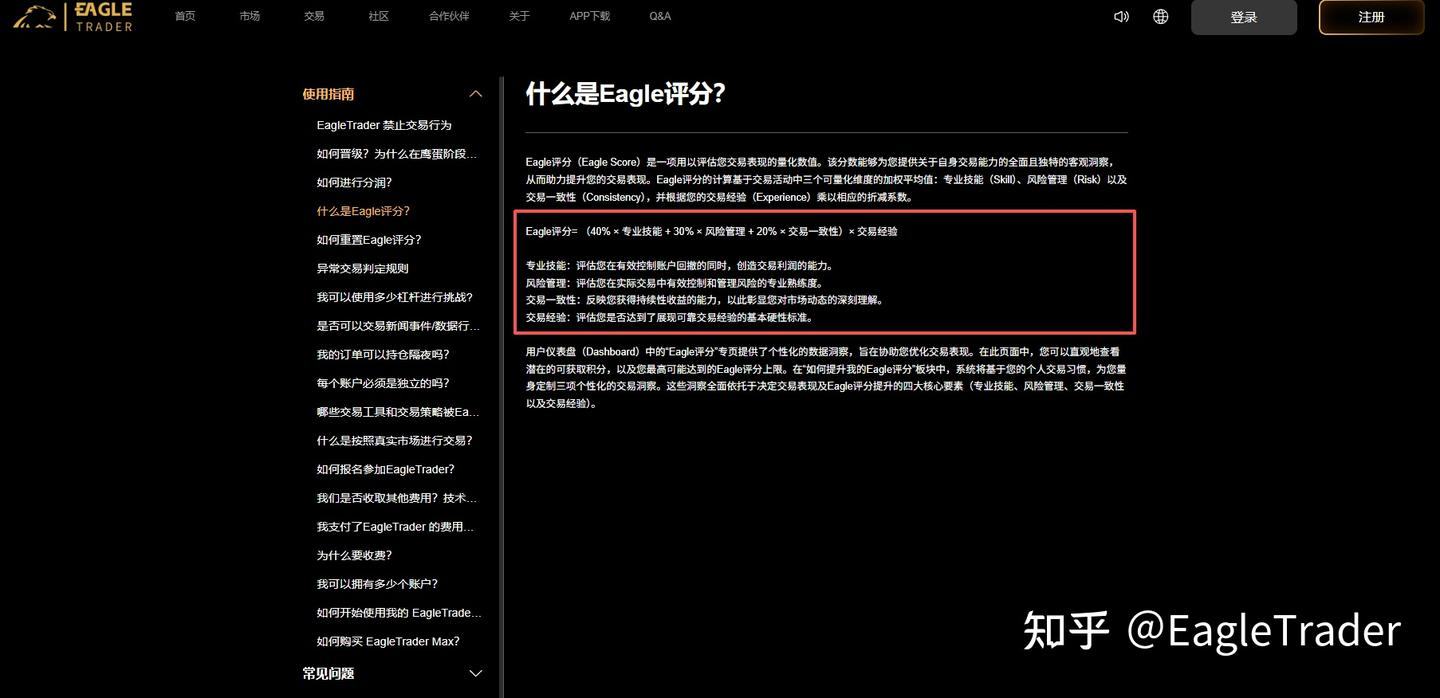
The official formula for the Eagle Score is:
Eagle Score = (40% × Professional Skill + 30% × Risk Management + 20% × Trading Consistency) × Trading Experience
The specific assessment criteria for each item are as follows:
1. Professional Skill (Skill, weight 40%)
Assessment content: Your actual profitability while effectively controlling drawdown.
Reasons for a low score: There may be flaws in the strategy's profitability and profit/loss logic, making stable profitability impossible.
2. Risk Management (Risk, weight 30%)
Assessment content: Risk control level, stop-loss execution, and position management in actual trading.
Reasons for a low score: Usually due to insufficient risk control execution, such as failing to strictly execute stop-losses when facing unfavorable market conditions, or position management exceeding a reasonable range.
3. Trading Consistency (Consistency, weight 20%)
Assessment content: Stability of trade execution, testing whether you have sustained profitability.
Reasons for a low score: Severe emotional trading, or excessive reliance on one or two heavy-position "gamble" profits to support overall returns.
4. Trading Experience (Experience)
Assessment content: Whether trading sample size and activity level meet the standard.
Reasons for a low score: Too few trades.
Due to insufficient sample size, the system cannot judge your true ability, and therefore cannot make an accurate assessment.
Why set this rule?
Tear Off the Subjective Filter
Many traders feel that their superior ability is the reason when they make a profit, and blame bad luck when they lose.
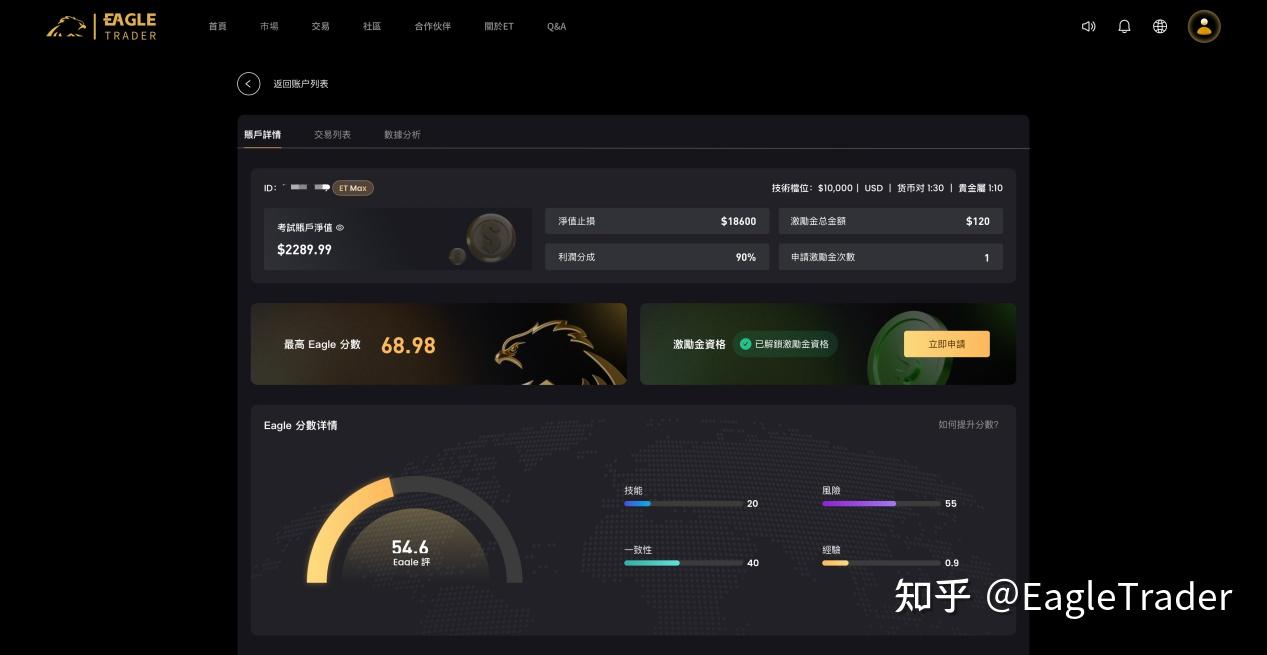
The Eagle Score uses objective data to break down a trader's ability, making it clear whether they are winning through professional skill or merely "betting" on luck.
Point Out the Direction for Upgrading
Blind effort often yields no results.
Through trade-by-trade quantitative scoring, traders can see at a glance whether their weakness lies in risk control, consistency, or professional skill, so they can make targeted adjustments and move their trading system toward maturity.
The establishment of proprietary trading rules is not meant to restrict trading, but to help traders improve their survival rate in the brutal market.
Therefore, thoroughly understanding these rules can not only help you avoid pitfalls in the challenge, but also gradually improve your trading system.
Since the rules are now clear, all that remains is to put them into practice.
Ready to take on EagleTrader Max?
No upfront evaluation stage. Trade immediately once funded, with up to 90% profit split.